BINAFET
Agriculture integrated into buildings and modelling strategies for air reuse in cities
- https://agrotech.upc.edu/en/projects-events/binafet
- BINAFET
- 2022-11-01T15:00:00+01:00
- 2024-11-30T16:00:00+01:00
- Agriculture integrated into buildings and modelling strategies for air reuse in cities
Nov 01, 2022 03:00 PM to Nov 30, 2024 04:00 PM (Europe/Madrid / UTC100)

Who is the project aimed at?
Researchers, policy-makers, urban planners, architects, engineers, companies in the construction and sustainability sectors, and public administrations interested in the ecological transformation of cities. It is also relevant to academic institutions and research centres committed to innovation in urban resource management and the promotion of sustainable, integrated urban agriculture.
Project objective
To develop and demonstrate an innovative strategy that enables the integration of flows between buildings and urban agriculture (UA), helping cities become more circular, intelligent and sustainable. The project aims to reduce the environmental impact of buildings by reusing flows such as CO₂, water and waste heat, while promoting local food production, improved air quality and energy efficiency.
Project description
Cities are responsible for 80% of global energy consumption, 70% of total waste generation and 60% of the planet's greenhouse gas emissions. It is therefore necessary to implement measures to transform cities into more sustainable and circular ecosystems.
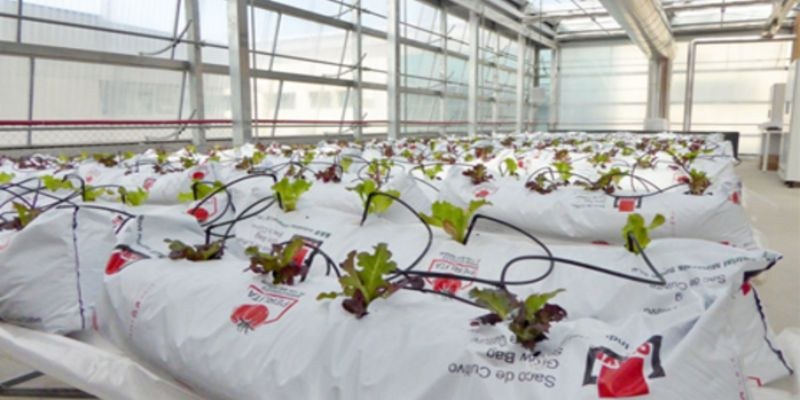
In this context, the BINAFET project, in which the UPC's Construction Research and Innovation Group (GRIC) participates, develops a strategy for integrating flows between buildings and urban agriculture (UA) as a key and necessary step towards the ecological transition of cities. This integration, supported by intelligent management, acts as a nature-based solution connecting a building with its greenhouse, creating synergies between the building's needs to minimise air temperature and CO₂ levels, and the benefits of local resources and vegetation. Waste flows generated by the building (for example, CO₂, waste heat and wastewater), together with UA, can be redirected to improve indoor air quality, the energy efficiency of the building and greenhouse, crop yields and local food production. These flows will be managed intelligently through predictive control and machine learning, contributing to the digital transformation.
The BINAFET project proposes a symbiotic interaction between buildings and urban agriculture to enhance circularity by generating flows of waste heat, wastewater and CO₂ to reduce energy consumption, support nutrient production, reduce urban water pollution and increase local food production. This system is based on improving indoor air quality in buildings and promoting sustainable local food production to improve people's health and quality of life. Making cities more sustainable is one of the major global challenges of the 21st century and requires strategies to mitigate and adapt to climate change, increase energy efficiency, and improve the management of natural resources and waste. The outcome will be a benchmark project for smart and efficient building-integrated agricultural solutions.
The project involves a team of researchers from the Universitat Politècnica de Catalunya - BarcelonaTech (UPC) and the Autonomous University of Barcelona (UAB). The UPC team comprises the Construction Research and Innovation Group (GRIC) and the Miquel Agustí Foundation (FMA). In particular, GRIC is responsible for modelling the performance of the building-integrated agriculture system proposed in the project, developing a prototype of smart building-integrated agricultural solutions to demonstrate the BINAFET concept, and working with the UAB team to analyse its feasibility and functionality in terms of scalability and sustainable performance.
A symbiotic interaction between buildings and urban agriculture is proposed. This interaction is based on the intelligent reuse of flows generated by the buildings themselves — such as waste heat, water and CO₂ — to supply agricultural production systems integrated into greenhouses installed on the buildings.
Through digitalisation, predictive control and machine learning, these flows will be managed to optimise the system's energy and agricultural performance. GRIC will develop performance models and prototypes of smart urban agriculture solutions, and will collaborate with the UAB to analyse the feasibility, sustainability and scalability of the BINAFET concept. The outcome will be a replicable model for the green transition in cities, aimed at improving health, quality of life and urban resilience to climate change.
Interested in the project?
Project funded by:

Share: