CANOPIES
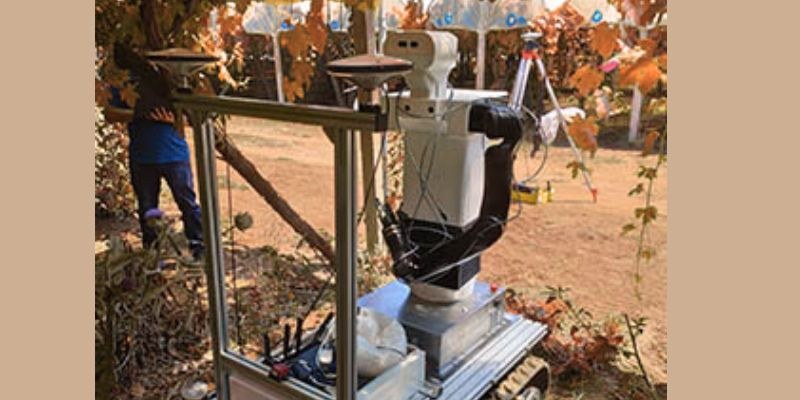
They develop cooperative robots to harvest table grapes
- https://agrotech.upc.edu/en/projects-events/canopies
- CANOPIES
- 2021-01-01T12:00:00+01:00
- 2025-02-08T13:00:00+01:00
- They develop cooperative robots to harvest table grapes
Jan 01, 2021 12:00 PM to Feb 08, 2025 01:00 PM (Europe/Madrid / UTC100)

Research group: UMA (Agricultural Mechanisation Unit)
Project: CANOPIES
Website: Canopies
Who the project is aimed at
Professionals and companies in the agri-food sector, especially table grape producers, agricultural engineers, farming cooperatives and researchers in precision agriculture, robotics and artificial intelligence. It is also of interest to those responsible for agricultural innovation and sustainability policies.
Project objective
To explore a new model of collaboration between people and robots to improve the efficiency, sustainability and productivity of agricultural tasks, such as grape harvesting and vineyard pruning, by developing intelligent robotic systems capable of working in cooperation with humans.
Project description
The project develops cooperative robots for complex agricultural tasks in permanent crops, such as vineyards, where the adoption of robotics has so far been very limited.
The robots being developed can communicate, collaborate with one another and interact with people. The IRI group, supported by the VIS group, is working to improve perception systems through computer vision, enabling robots to identify grapes at the optimal stage of ripeness and accurately detect branches that need pruning.
At the same time, UMA focuses its efforts on integrating functions traditionally performed by agricultural machinery into the robots, enabling them to carry out operations such as grape harvesting, pruning and transport. The project requires the development of advanced technologies for perception, planning, prediction of human intentions and collaborative action.
CANOPIES represents a commitment to modernising traditional agriculture, promoting a more sustainable, efficient and technologically advanced model, with a significant potential impact on the sector's competitiveness and the quality of the final product.
Funded by the European Union's Horizon 2020 research and innovation programme

Share: