SYMBIOSYST
UPC technology to generate clean energy for the agricultural sector in Europe
- https://agrotech.upc.edu/en/projects-events/symbiosyst
- SYMBIOSYST
- 2023-01-01T10:00:00+01:00
- 2026-12-30T11:00:00+01:00
- UPC technology to generate clean energy for the agricultural sector in Europe
Jan 01, 2023 10:00 AM to Dec 30, 2026 11:00 AM (Europe/Madrid / UTC100)

UPC research groups involved: GRIC, CDEI, IDEAI, HorPTA
Project website: SYMBIOSYST Project
Who is the project aimed at?
Agricultural professionals, agri-food companies, energy sector companies, renewable energy researchers, environmental policymakers and investors interested in sustainable agricultural solutions with a low carbon footprint.
Project objective
Promote the integration of agricultural activities and solar energy production through agrivoltaic systems (agri-PV), developing technological solutions and sustainable models that enable clean energy generation in agricultural environments, minimise environmental impact and foster more efficient and competitive agriculture in Europe.
Project description
An initiative led by a consortium of 16 European partners, including the Universitat Politècnica de Catalunya - BarcelonaTech (UPC), which aims to address Europe's challenge of achieving net-zero emissions by 2050. The project focuses on agri-PV, a technique that allows the same land to be used for both agriculture and solar energy generation, thereby increasing land profitability and the sustainability of agricultural activities.
UPC is involved through the Agrotech-UPC Specific Research Centre and several research groups and centres. The Construction Research and Innovation Group (GRIC) will design sustainable support structures for solar panels, analyse systems and develop business models. The Centre for Industrial Equipment Design (CDEI) will create a sensor-equipped mobile robot to optimise the angle of solar panels in real time, while the IDEAI centre will develop digital twins to simulate and optimise the overall performance of the agri-PV system. In addition, the Department of Agri-Food Engineering and Biotechnology will assess the effects of solar installations on the production and quality of different horticultural crops.
The results will be implemented at four European agricultural demonstrators, including a pilot project at Agròpolis (UPC, Viladecans), where agri-PV strategies will be tested under real-world conditions. The project aims to generate new products and services for the sector, improve energy efficiency, promote low-carbon food production and stimulate new technological investments in rural areas across Europe.
Results
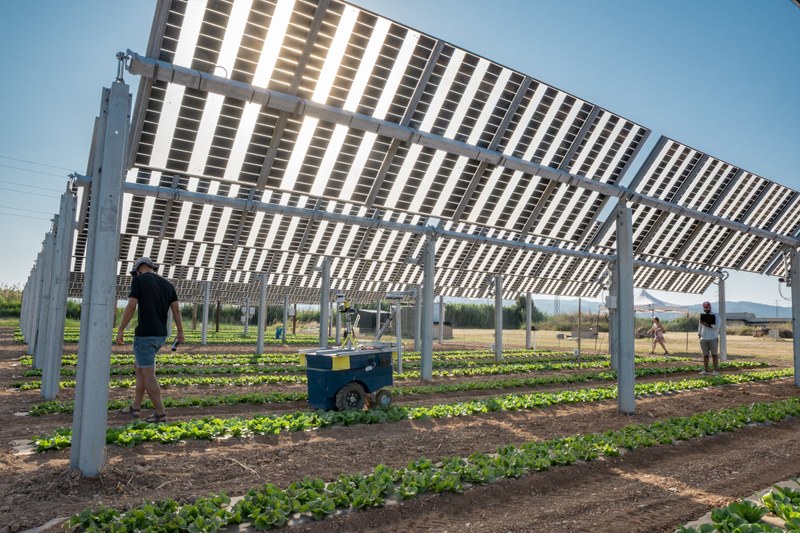
At the agrivoltaic plant installed at UPC's Agròpolis, the impact of agrivoltaics on the quality and productivity of horticultural crops is being analysed under real-world conditions. Specifically, the research examines the effects of two types of photovoltaic panels on these crops, with different photovoltaic cell densities and, consequently, different levels of light transparency. The installation consists of 150 solar photovoltaic panels with a total capacity of 50.25 kilowatts (kW), capable of generating approximately 400 kWh per day, equivalent to the daily electricity consumption of 30 to 40 households.
The solar panels are mounted on 10 solar trackers (mechanical devices that orient the panels to optimise sunlight interception), allowing them to follow the sun's path from sunrise in the east to sunset in the west. This system supports crop growth while maximising energy production. Five of these trackers are equipped with solar panels with 5% light transparency, while the other five use panels with 40% transparency. Panel movement is controlled using mathematical models that take into account current climatic variables, crop light requirements and plant growth models.
In addition, the growing area is equipped with aerial sensors—which measure climatic variables—and soil sensors that record moisture and temperature. Hyperspectral imaging is also used to monitor crop growth via a mobile robot, providing real-time, geolocated data from the three experimental areas (two beneath solar panels with different transparency levels and one in the open field). These data will be used to develop a digital twin to support immediate and short-term decision-making in solar panel management, with the aim of optimising production.
The effects of the two types of panels on the development, physiology, yield and quality of the horticultural species grown, such as lettuce, broccoli and tomatoes, are also being studied.
Summer trials conducted to date have not produced conclusive results regarding agricultural production, nor have they revealed significant differences between the various growing areas under summer conditions. During the winter period, the same parameters will be analysed, taking into account that light and temperature conditions may be more limiting factors for certain horticultural crops.
A benchmark installation
This project could represent a step forward in multidisciplinary research and knowledge transfer in the horticultural sector.
- It is a benchmark installation, and the results obtained will be crucial in assessing whether agrivoltaics is a suitable technology for moving towards mixed production systems (energy and food) and for defining operating protocols. It will also provide additional tools for developing evidence-based policies, regulations and support schemes for agrivoltaic installations.
- The installation of agrivoltaic plants opens up opportunities for farmers to benefit from energy production, whether through self-consumption at their facilities or by selling energy on the market. This can contribute to the economic sustainability of farms and to balanced territorial development.
Project funded by the HORIZON-101096352-SYMBIOSYST programme

Share: