Valsucanem
New green composite materials from the valorisation of hemp by-products
- https://agrotech.upc.edu/en/projects-events/valsucanem
- Valsucanem
- 2020-11-01T12:00:00+01:00
- 2023-11-30T03:00:00+01:00
- New green composite materials from the valorisation of hemp by-products
Nov 01, 2020 12:00 PM to Nov 30, 2023 03:00 AM (Europe/Madrid / UTC100)
Research group: CATMech
Project: Valsucanem
Website
Target audience
Companies in the construction sector, manufacturers of sustainable materials, researchers in the circular economy, and organisations interested in valorising agricultural by-products as an alternative to conventional materials.
Project objective
To study the feasibility of reusing hemp shives, a hemp by-product traditionally considered waste, to develop sustainable materials for the construction sector, increasing their value and contributing to a more circular economy with lower CO₂ emissions.
Project description
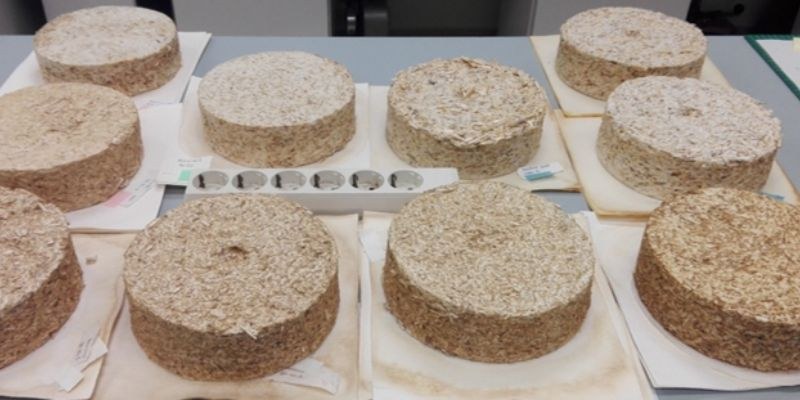
CATMech, a research group at the Universitat Politècnica de Catalunya - BarcelonaTech (UPC), has participated in the VALSUCANEM circular economy project in collaboration with the company Lloveras Planteles SL. The project has investigated the valorisation of hemp shives to produce a composite material for five construction applications: thermal and acoustic insulation, particleboards, construction void formers and parquet flooring.
The project's main technological challenges have been developing a recyclable, bio-based resin to bind the hemp shives, achieving mechanical properties and durability suitable for construction applications, and creating a proof of concept. The most significant result has been an insulation material made from 70% hemp shives and 30% recycled cardboard fibre, with insulation properties comparable to those of other commercially available materials. The incorporation of plant-based coatings such as gum arabic or rosin, as well as the use of citric acid to improve moisture resistance, is being explored. The material has passed a 12-month durability test without degradation, and its life cycle assessment indicates the potential for negative CO₂ emissions when manufactured efficiently at an industrial scale.
Project carried out with the support of ACCIÓ, the Government of Catalonia (Ref. ACE014/20/000024)

Share: